
The Value Driver Checklist: Is Your Business “Transferable”?
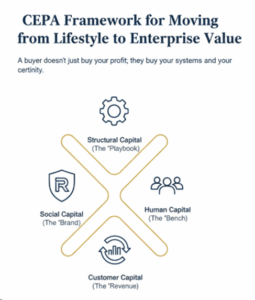
A buyer doesn’t just buy your profit; they buy your systems and your certainty. Use this checklist to identify where your business stands on the scale of “Attractive and Ready.”
- Structural Capital (The “Playbook”)
- Standard Operating Procedures (SOPs): Are your core processes documented, or do they live in your head (the “Owner’s Trap”)?
- Technology Stack: Is your software scalable and integrated, or is it a patchwork of manual workarounds?
- Financial Integrity: Do you have three years of clean, reviewed, or audited financials? (A buyer’s due diligence starts here).
- Human Capital (The “Bench”)
- Management Depth: Can the business operate for 30 days without your involvement?
- Key Employee Retention: Are there “stay bonuses” or non-compete/non-solicitation agreements in place for your most critical talent?
- Culture: Is there a performance-based culture that exists independently of the owner’s personality?
- Customer Capital (The “Revenue”)
- Concentration Risk: Does any single customer represent more than 10-15% of your total revenue?
- Recurring Revenue: What percentage of your income is “contractual” vs. “transactional” (starting at zero every month)?
- Diversity: Is your customer base spread across different industries to weather a recession?
- Social Capital (The “Brand”)
- Brand Independence: Does the brand name belong to the company, or is it tied to your personal name and reputation?
- Market Position: Can you clearly articulate your “moat”—the reason customers choose you over a cheaper competitor?
- Digital Presence: Is your online reputation and lead generation system automated and consistent?
The “CEPA” Scoring Guide
- Mostly “Yes”: You have a Premium Asset. You are likely in the top 20% of businesses and can command a higher-than-average industry multiple.
- A Mix of “Yes” and “No”: You have a Lifestyle Business. It provides income, but a buyer will heavily discount the price due to the “Risk Gap.”
- Mostly “No”: You have a Job. Your business is currently difficult to sell, regardless of how much profit you are taking home.
5 Most Recent Articles
 8 Drivers That Determine What Your Business Is Really Worth!July 6, 2026 - 8:00 am
- Why Every Business Owner Needs an Exit Plan!June 17, 2026 - 2:53 pm
- Why Every Business Owner Needs an Exit Plan!June 15, 2026 - 8:00 am
- Are You Building a Business- or Just a Job?June 5, 2026 - 8:00 am
- Reduced Risk – The Hidden MultiplierMay 18, 2026 - 10:00 am


