
8 Drivers That Determine What Your Business Is Really Worth!
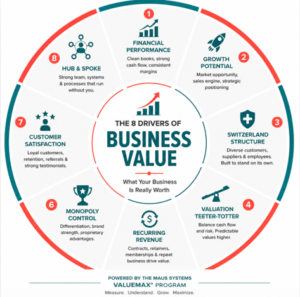
Most business owners think about value in terms of revenue or profit. But when a buyer, investor, or successor evaluates your company, they’re looking at something much more complex – and much more controllable than you might think. The Maus Systems Valuemax Program identifies 8 core drivers that shape the transferable value of any business. These aren’t abstract concepts. They’re the levers you can pull right now to build a stronger, more valuable, more exit-ready company.
- Financial Performance
Buyers pay for predictable, growing cash flow – not just last year’s numbers. Strong financial performance means clean books, consistent margins, and a clear story about where revenue comes from and where it’s going. If your financials require a decoder ring, they’re costing you value.
- Growth Potential
A business with a clear, credible path to future growth commands a premium. Buyers aren’t just buying today’s earnings – they’re buying tomorrow’s. Documented market opportunity, a repeatable sales process, and strategic positioning all signal that the best days are ahead, not behind.
- Switzerland Structure
This driver is about independence – not in politics, but in your business relationships. Over-reliance on any single customer, supplier, or employee is a red flag that drives value down. A business that can lose its top client and still survive is worth significantly more than one that can’t.
- Valuation Teeter-Totter
Cash flow is king, but how you generate it matters too. The teeter-totter represents the balance between cash flow and risk. Recurring revenue models, subscription income, and long-term contracts tilt the teeter-totter in your favor by making future cash flow more certain and therefore more valuable.
- Recurring Revenue
Nothing increases business value faster than predictable, recurring income. Whether it’s service contracts, retainers, memberships, or repeat customer relationships, recurring revenue reduces risk and multiplies what a buyer is willing to pay. One-time transactions leave value on the table.
- Monopoly Control
Businesses that dominate a niche command premium valuations. Monopoly control doesn’t mean you’re the only player – it means you own something distinctive: a proprietary process, a trusted brand, a loyal community, or a specialized capability that competitors can’t easily replicate. Differentiation protects your margins and your multiple.
- Customer Satisfaction
Happy customers aren’t just good for business – they’re a signal to buyers. High Net Promoter Scores, strong retention rates, and documented testimonials demonstrate that the value your business delivers is real and sustainable. A company with loyal customers is a company with durable cash flow.
- Hub & Spoke
Is your business built around you – or built to run without you? If you’re the hub of every important decision, relationship, and operation, you’re not selling a business. You’re selling a job. Buyers pay a premium for companies with strong management teams, documented systems, and the ability to operate independently of their founder.
The Bottom Line
Value isn’t something that just happens at exit – it’s built deliberately, driver by driver, over time. At Weiss Advisors, we use the Maus Systems Valuemax framework as one of our core diagnostic tools to help business owners see exactly where they stand and where to focus. Whether you’re planning to exit in two years or ten, understanding these 8 drivers is the first step toward building a business that’s truly worth what you’ve put into it.
5 Most Recent Articles
 8 Drivers That Determine What Your Business Is Really Worth!July 6, 2026 - 8:00 am
- Why Every Business Owner Needs an Exit Plan!June 17, 2026 - 2:53 pm
- Why Every Business Owner Needs an Exit Plan!June 15, 2026 - 8:00 am
- Are You Building a Business- or Just a Job?June 5, 2026 - 8:00 am
- Reduced Risk – The Hidden MultiplierMay 18, 2026 - 10:00 am


