
What is a Buy-Sell Agreement?

A buy-sell agreement, also known as a buyout agreement, is a legally binding contract that outlines how a partner’s share of a business will be reassigned if they decide to leave, retire, or pass away. In simpler terms, it acts as a safety net for business owners, ensuring the seamless transfer of ownership while protecting the company’s continuity. Whether you are starting a business or managing a well-established one, understanding and implementing a buy-sell agreement can safeguard your investment and relationships.
Why Is a Buy-Sell Agreement Important?
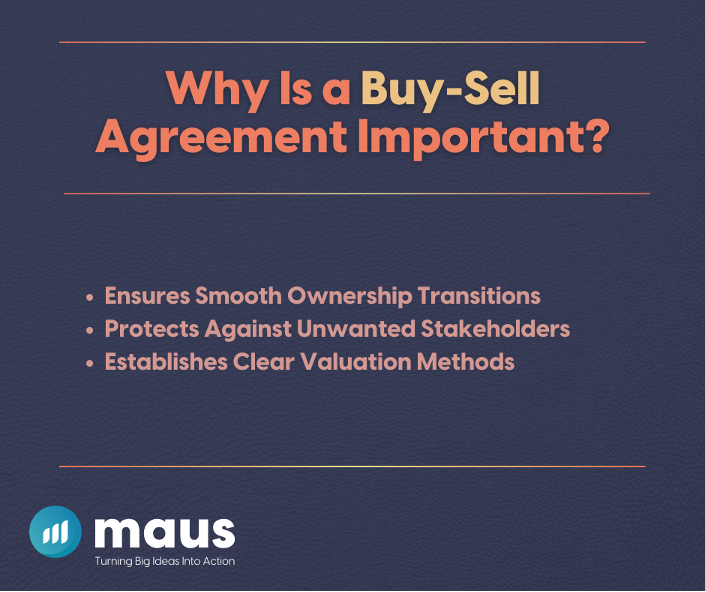
A buy-sell agreement plays a critical role in ensuring the stability and longevity of a business. Here are three key reasons why every business with multiple owners should consider having one:
Ensures Smooth Ownership Transitions
When a partner leaves the business due to retirement, disability, or death, the remaining partners can face uncertainty. A buy-sell agreement outlines transferring ownership, ensuring the business continues without disruption.
Protects Against Unwanted Stakeholders
Without a buy-sell agreement, business shares could be inherited by a family member or sold to an outside party. This could lead to conflicts or bring in stakeholders unfamiliar with the business. A well-crafted agreement prevents this by restricting ownership transfer to approved parties.
Establishes Clear Valuation Methods
One of the significant benefits of a buy-sell agreement is that it provides a clear process for determining the value of the business. This prevents disputes over share pricing and ensures that all parties receive fair compensation. These agreements can also play a key role in succession planning for family-run businesses.
4 Types of Buy-Sell Agreements
Several types of buy-sell agreements are suited to different business needs.
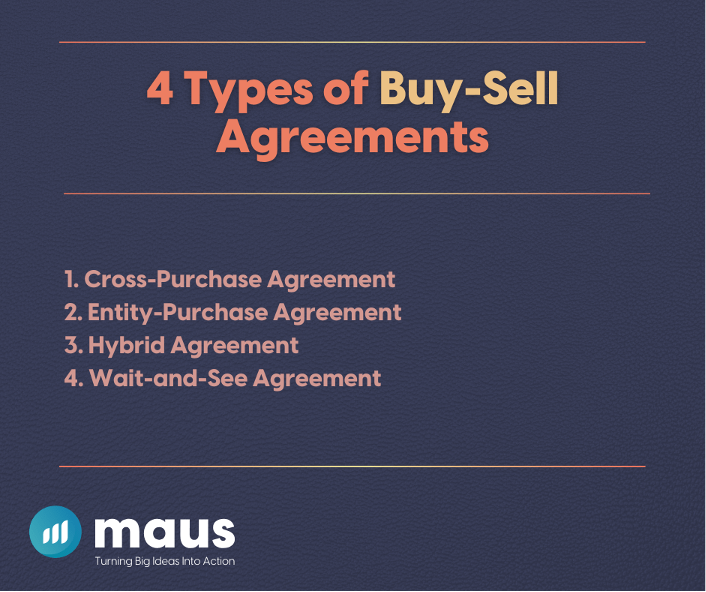
Let us explore the most common ones:
- Cross-Purchase Agreement
The remaining business owners agree to buy the departing owner’s share in a cross-purchase agreement. Each owner typically holds a life insurance policy on the others, using the payout to fund the buyout. This type of agreement is ideal for small businesses with few owners.
- Entity-Purchase Agreement
Also known as a redemption agreement, this structure allows the business entity itself to purchase the departing owner’s shares. The company holds life insurance policies on each owner, providing the funds for the buyout.
- Hybrid Agreement
A hybrid buy-sell agreement combines elements of both cross-purchase and entity-purchase agreements. It provides flexibility by allowing either the business or the remaining owners to purchase the departing owner’s shares, depending on the situation.
- Wait-and-See Agreement
This type of agreement postpones the decision on who will purchase the departing owner’s share until a triggering event occurs. It offers maximum flexibility but requires detailed planning to satisfy all parties.
Key Elements of a Buy-Sell Agreement
A comprehensive buy-sell agreement should cover the following:
Triggering Events
Identify situations that will activate the buy-sell agreement, such as death, disability, retirement, or bankruptcy.
Valuation Method
Specify how the business will be valued (e.g., fixed price, independent appraisal, or formula-based approach).
Funding Mechanism
Outline how the buyout will be funded—often through life insurance policies, cash reserves, or installment payments.
Restrictions on Ownership Transfer
Details who can and cannot become shareholders to prevent ownership from falling into undesirable hands.
Tax Implications
Include provisions addressing potential tax liabilities for the business and individual owners.
5 Steps to Create a Buy-Sell Agreement
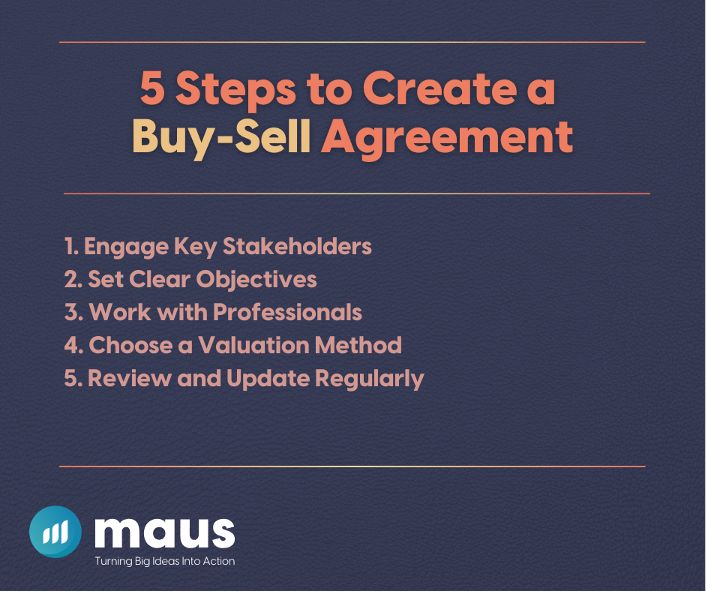
Crafting an effective buy-sell agreement requires careful planning. Here are the essential steps:
- Engage Key Stakeholders
Involve all business owners in the discussion to ensure mutual understanding and agreement on terms.
- Set Clear Objectives
Define what the agreement aims to achieve, whether it is ensuring business continuity, maximizing financial returns, or both.
- Work with Professionals
Collaborate with attorneys, accountants, and Certified Exit Planning Advisors (CEPA) to draft a legally sound and comprehensive agreement.
- Choose a Valuation Method
Select a valuation approach that suits your business needs.
- Review and Update Regularly
Your buy-sell agreement should be revisited and revised as your business evolves to reflect changing circumstances and business values.
3 Common Challenges and How to Overcome Them
- Valuation Disputes
Solution: Use a neutral third-party appraiser to establish a fair market value.
- Funding Shortfalls
Solution: Secure life insurance policies or establish a sinking fund to cover buyout costs.
- Conflicts Among Owners
Solution: Clearly define terms and include dispute resolution mechanisms in the agreement.
Conclusion: Protect Your Business Today
A buy-sell agreement is more than just a legal document; it is a roadmap for ensuring your business thrives even under challenging circumstances. By establishing clear terms and planning for future contingencies, you can protect your company, partners, and legacy.
Now is the time to invest in you, your family, and your business.
5 Most Recent Articles
 Are You Building a Business- or Just a Job?June 5, 2026 - 8:00 am
- Reduced Risk – The Hidden MultiplierMay 18, 2026 - 10:00 am
- How Scalable Systems Boost Your Business ValueMay 4, 2026 - 10:00 am
- Why Your Business Needs to Run Without YouApril 20, 2026 - 8:00 am
- Why Predictable Cash Flow Matters More Than ProfitApril 6, 2026 - 8:00 am


